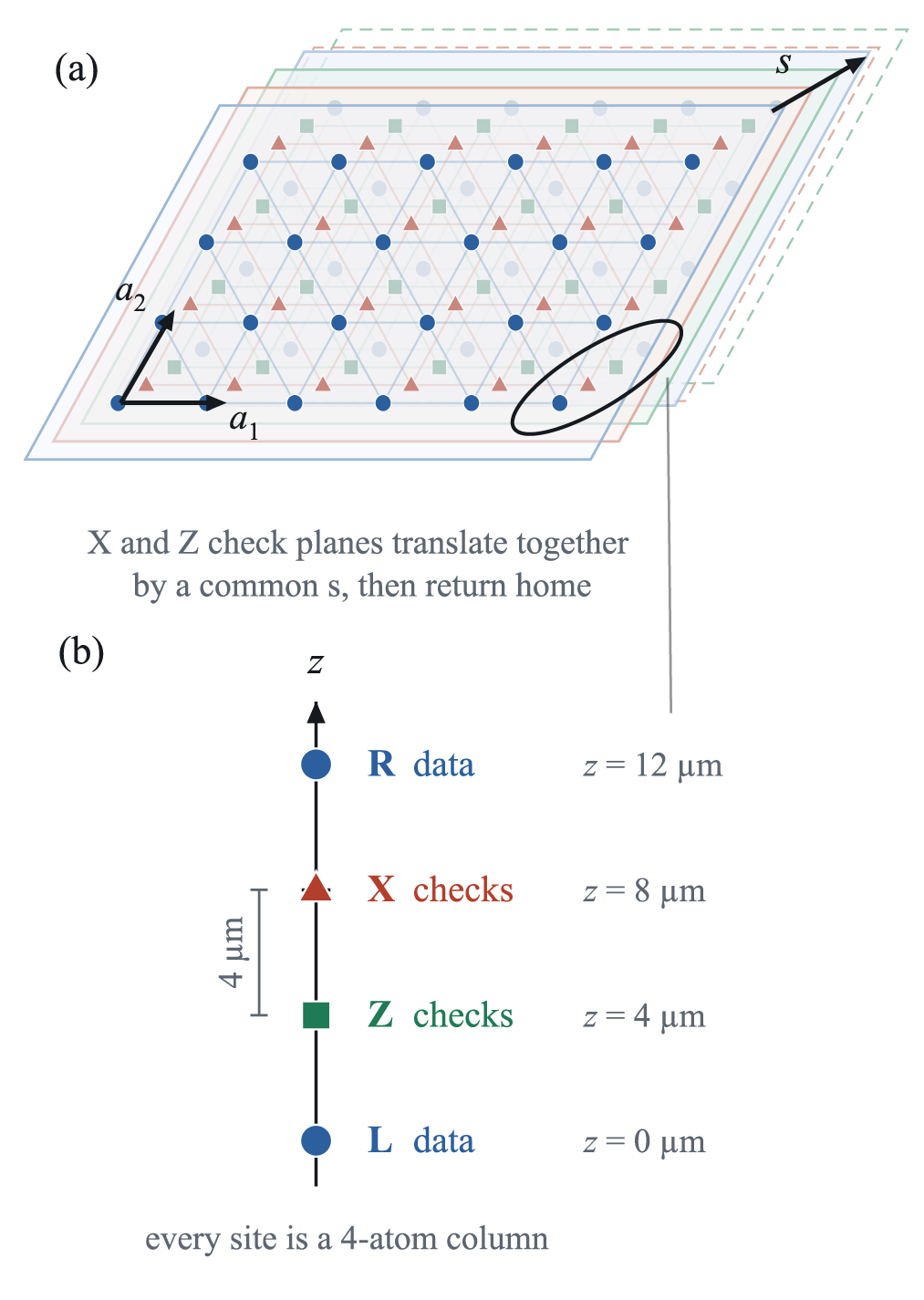
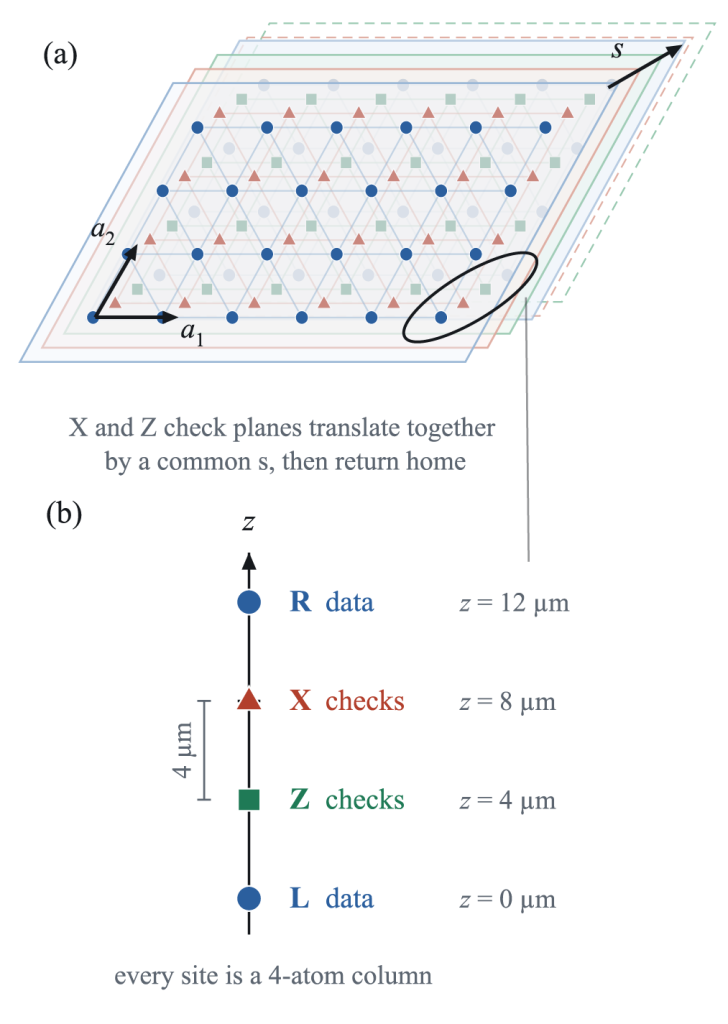
Error-correcting codes in the qLDPC family use far fewer physical qubits than the surface code, but their error checks connect qubits that sit far apart — and on neutral-atom hardware that distance is paid for by physically carrying atoms across the array, which is slow.
We took one fixed code, the [[144,12,12]] bivariate bicycle code, and laid it out across four stacked planes instead of flat. The 3D layout fits about 4× more logical qubits into the same optical field of view and completes each round of error checking about twice as fast.
These gains come from the geometry the hardware can supply, not from the code. They motivate the development of three-dimensional optical control technologies for qubit manipulation: uniform tweezer arrays throughout a volume, addressing and transport at any depth, and simultaneous multi-plane readout.
Kevin Yipu Wu, Ohik Kwon, and Maxwell F. Parsons, “Efficient Quantum Error Correction from Three Dimensional Qubit Control,” arXiv:2609.04459.
Leave a Reply