
This project (source code) develops a reproducible end-to-end pipeline for LEO NTN channel modeling, from satellite orbit and scene generation to ray-traced propagation, CIR/TDL construction, and statistical channel characterization. The framework connects orbital dynamics and site-specific geometry to the temporal evolution of multipath, delay, Doppler, and other channel statistics, while providing a consistent workflow for evaluating channels over an entire satellite pass. The resulting models are compared against 3GPP TR 38.811 as a baseline to quantify where geometry-aware, site-specific modeling departs from conventional standardized channel assumptions.
Research Motivation
3GPP TR 38.811 provides an important baseline for NTN channel modeling, but its statistical channel characterization offers limited physical insight into why particular delay, Doppler, K-factor, or multipath behaviors arise. Moreover, the underlying propagation geometry and the complete simulation parameters used to generate several reported results are not disclosed, making those results difficult to independently reproduce or physically interpret. This motivates a site-specific approach in which the satellite trajectory and surrounding environment are modeled explicitly, allowing individual propagation mechanisms and their evolution over a satellite pass to be directly examined.
However, conventional off-the-shelf ray-tracing tools are primarily designed for terrestrial links and do not directly support key NTN requirements such as orbital motion, satellite-scale link distances, time-varying geometry, and the associated Doppler evolution. This work therefore extends Sionna RT with NTN-specific geometry and propagation support and develops a reproducible pipeline from site-specific ray tracing to statistical channel modeling. The pipeline is used to derive channel statistics from physically generated propagation data and to independently reproduce, validate, and interpret the statistical trends reported in 3GPP TR 38.811.
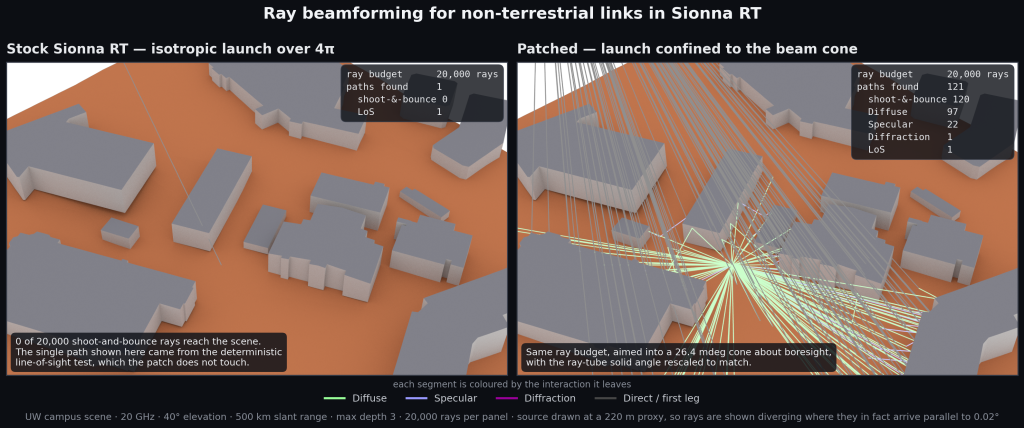
Comparison of default Sionna RT NTN simulation against patched NTN Sionna RT implementation
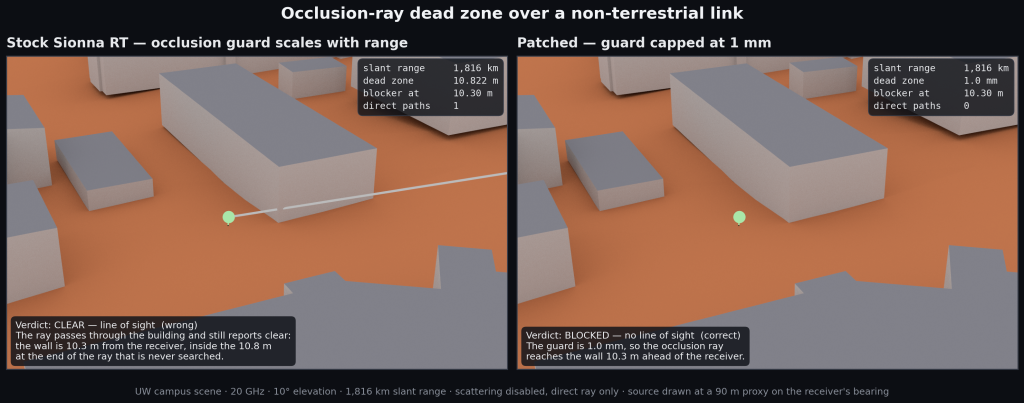
What’s new compared to stock Sionna RT
| Capability | Stock Sionna RT | Our Sionna NTN Extension |
| Beam-aware ray tracing | Initial candidate rays are sampled over the full sphere, independent of the transmit beam direction. For narrow satellite beams and long-distance NTN links, only a small fraction of rays may interact with the relevant local scene. In a 600km LEO, there is only 1 or 2 ray reach the local scene according to our test. (see this figure above) |
Concentrates ray launching within the satellite beam region according to the antenna pointing and beam pattern, improving sampling efficiency for far-field NTN propagation. |
| Orbital propagation | No satellite orbit or constellation model. | Integrates SGP4 propagation and TLE data to generate time-varying satellite position, velocity, elevation, range, and viewing geometry over an orbital pass. |
| Circular polarization | Built-in antenna polarization models primarily support linear single- and dual-polarized configurations. | Adds circular-polarization modeling required for satellite links, including polarization-dependent propagation and antenna response. |
| Atmospheric and ionospheric propagation | No native NTN atmospheric or ionospheric propagation model. | Adds satellite-specific atmospheric and ionospheric effects, including atmospheric attenuation and ionospheric Faraday rotation, to the ray-traced channel. |
Research Objectives
- Geometry-dependent channels: investigate how satellite position and the local scene influence channel power, delay, angular structure, and Doppler behavior.
- Model comparison: compare site-specific channel behavior with statistical reference models under matched scenarios.
- Reproducible evaluation: document scene geometry, material and antenna assumptions, and simulation settings so comparisons can be interpreted and repeated.
Connection to Network Simulation
The channel-modeling work complements FUNLAB’s ns-3-NTN project. Sionna RT focuses on the propagation environment and channel generation, while ns-3-NTN focuses on the resulting network behavior, including scheduling, HARQ, throughput, and delay. Connecting these levels is a research objective for evaluating satellite networks under site-specific propagation conditions.